Okuma Corporation · Year ended March 2026
Okuma brings bearing diagnosis down to about three minutes
Okuma makes machine tools, including lathes and machining centers, that cut metal into parts. It supplies manufacturers in industries such as automotive and aerospace, and also develops the CNC controls that direct its machines’ movements.
Okuma’s spindle-bearing diagnostic-time comparison
Published May 2026. About one hour is expressed as 60 minutes. The company compares a process including measurement, data handling and assessment, not total factory downtime.
Source: Okuma, AI machine-diagnosis development, page 2 (Japanese). The document does not provide detailed measurement conditions or the number of machines tested for this comparison.
Use information inside the control, without adding a sensor
From a bearing check to a maintenance decision
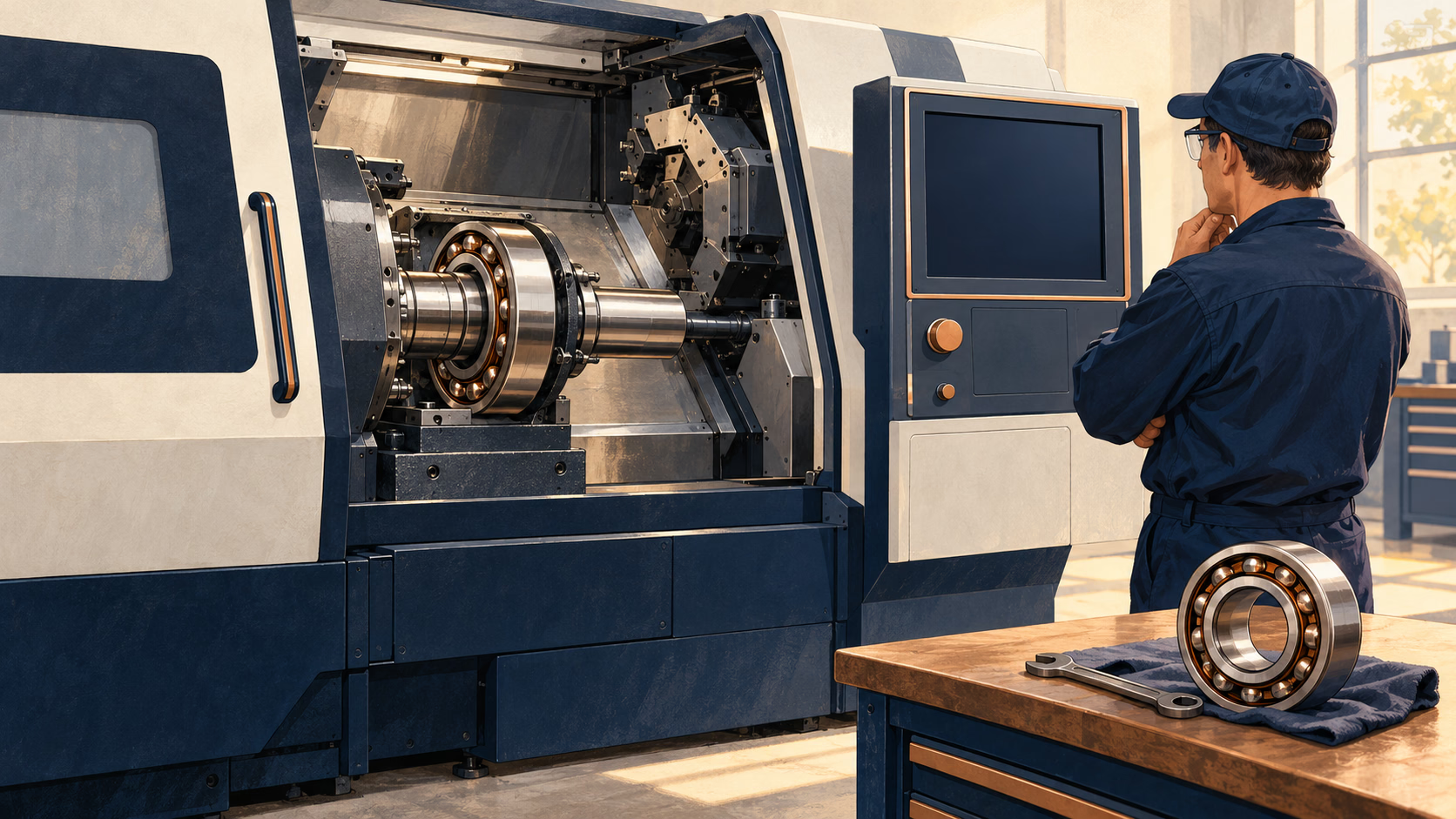
A schematic of the work described in the May 2026 release.
Attach, measure, assess
A person attaches a sensor to the spindle-bearing area, uses an instrument and organizes the results. This is the conventional process described by Okuma.
Use the CNC’s internal information
For the new turning-spindle diagnosis, the machine’s own control completes measurement, data handling and assessment without an additional sensor.
Use the result in maintenance
Early detection can support planned parts replacement. The diagnosis does not itself perform a repair.
The cutaway and parts are explanatory drawings, not the dimensions or exact internal layout of a particular model. The sensorless step refers to turning spindles; milling-spindle-bearing diagnosis uses a vibration sensor.
Test field data in the company’s own inspection process
Use machine-control information in maintenance
An editorial summary of relationships described by the company.
- Internal informationUsed for turning-spindle diagnosis
- Field dataTraining, validation and in-house inspection
- Maintenance decisionsFrom early detection to planned parts replacement
Keep model coverage separate from company-wide sales
THE VIEW AFTER THE NUMBERS
What the numbers suggest
Primary sources used
AI machine-diagnosis development (Japanese)
Okuma Corporation · 2026-05-08
Pages used: p.1 / p.1-2 / p.2
Open source →FY2025 Results Presentation (Japanese)
Okuma Corporation · 2026-05-19
Pages used: p.4
Open source →Financial Results for the Year Ended March 2026 (Japanese)
Okuma Corporation · 2026-05-12
Pages used: p.1
Open source →