Motorcycle technology branched into the sea and the factory floor: Yamaha Motor at ¥2.53 trillion.
Yamaha Motor began with the YA1 motorcycle in 1955. Seventy years later, Land Mobility—still centered on motorcycles—generated ¥1.6151 trillion in FY2025, about 63.7% of group revenue by site calculation. So this is not a story about motorcycles becoming irrelevant. It is a story about what happened to the engineering built around them. The first Yamaha outboard motor in 1960 was designed to share parts with the YA1. Industrial robots were first developed for Yamaha's own production lines before external sales began in 1976. Today the company spans Marine, Robotics and Financial Services while motorcycles remain at the center.
This is not investment advice or a stock recommendation. We reorder company-published primary-source facts to make the shape of the business easier to see.
Yamaha Motor started with a motorcycle.
Seventy years later, motorcycles and related mobility are still the company’s economic center.
But the engineering built around that center has branched much farther.
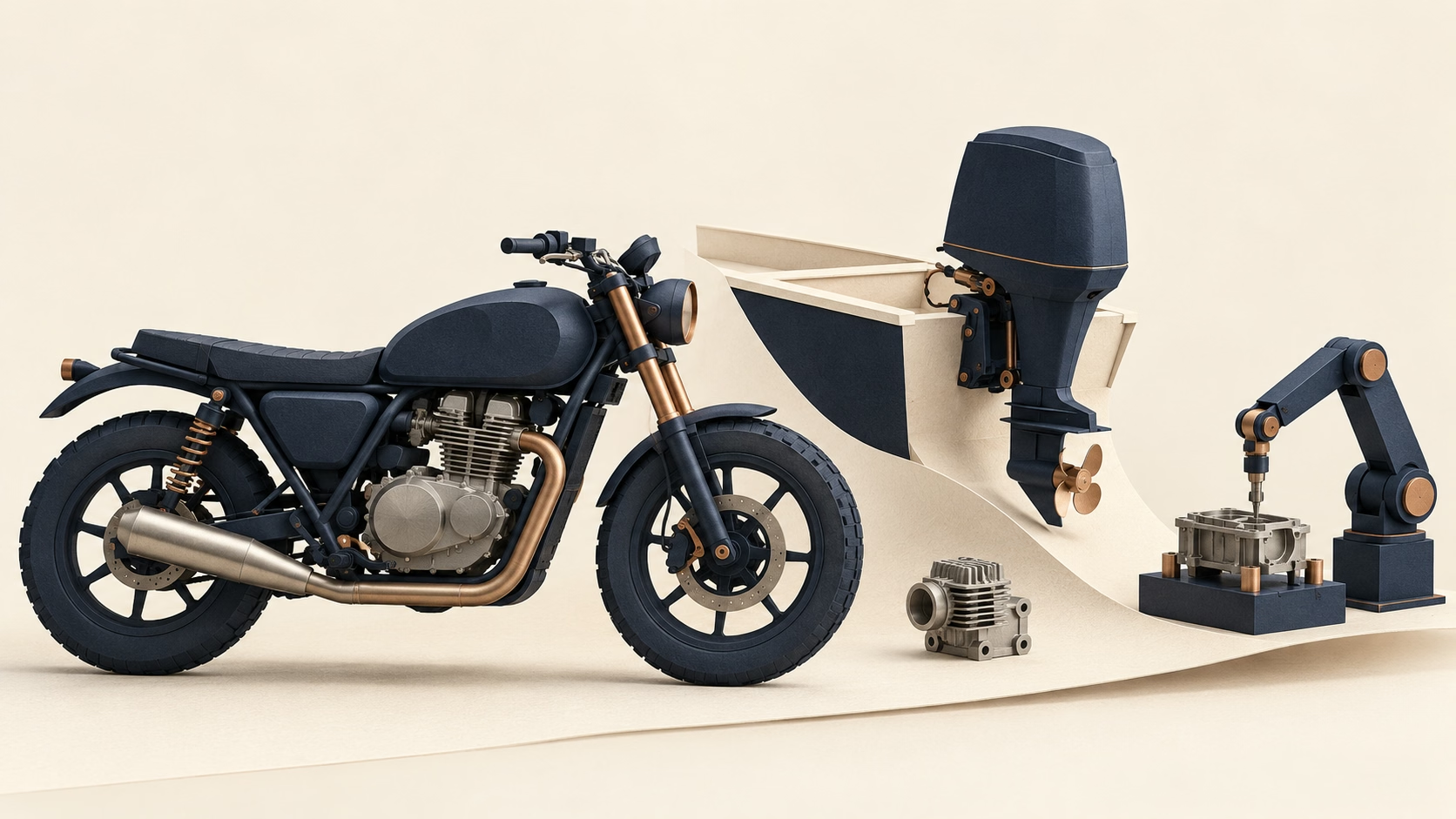
THE ARTICLE IN ONE IMAGE
Motorcycle, outboard and manufacturing maquettes interpret branches of powertrain and production capabilities. Not actual specifications, a direct lineage for every business or a claim that all branches are profitable.
Revenue is ¥2.5342 trillion
Land Mobility still generates ¥1.6151 trillion
Marine is a ¥527.6 billion business
DATA VIEW
Yamaha Motor's FY2025 segment revenue
Billions of yen; company-disclosed segment revenue.
Land Mobility¥1,615.1bn
Marine¥527.6bn
Outdoor Land Vehicle¥148.5bn
Financial Services¥114.0bn
Robotics¥111.5bn
Others¥17.4bn
Not every branch of this portfolio is equally profitable.
Outdoor Land Vehicle lost ¥39.8 billion
Robotics generates ¥111.5 billion
Financing grew around the products
The branching began soon after the company was created.
The first product was the YA1 in 1955
In 1960, YA1 parts moved onto the water
Another branch grew inside Yamaha’s own factories.
Robots built for Yamaha’s factories went on sale in 1976
Yamaha Motor itself describes the portfolio as a continuity of capabilities, not just a collection of unrelated products.
Powertrains, chassis and control connect the branches
Motorcycles still matter enormously.
But looking only at motorcycles hides both the scale of Marine and the path that led Yamaha into factory automation and semiconductor equipment.
THE VIEW AFTER THE NUMBERS
What the numbers suggest
Yamaha Motor generated ¥2.5342 trillion of revenue and ¥126.4 billion of operating profit in FY2025.
Land Mobility produced ¥1.6151 trillion, about 63.7% of group revenue by site calculation. It remains the economic center.
Yet the first P-7 outboard in 1960 was designed to share parts with the YA1, and Marine has since grown to ¥527.6 billion of revenue. Industrial robots began as tools for Yamaha’s own production lines before outside sales started in 1976, leading to today’s Robotics business.
In FY2025, semiconductor back-end equipment demand grew for generative-AI applications and advanced packaging. At the same time, Outdoor Land Vehicle recorded a ¥39.8 billion operating loss, showing that diversification has not made every branch equally successful.
Yamaha Motor did not leave motorcycles behind. It branched motorcycle-era engineering and manufacturing capabilities into the sea, the factory floor and finance.
Makita generated ¥777.6bn of revenue and ¥104.7bn of operating profit in FY2025. Overseas revenue was ¥645.5bn, about 83.0% of the total by site calculation, while Europe alone contributed ¥390.1bn, or about 50.2%. Overseas factories produced 92.5% of units. Makita began in 1915 as a sales and repair business for motors, transformers and lighting equipment, launched Japan’s first portable electric planer in 1958, and shifted into power tools in 1959. Its first cordless tool followed in 1969 and lithium-ion professional cordless tools in 2005. Today Makita is expanding beyond power tools into OPE, cleaning and outdoor products under its goal of becoming a supplier of a comprehensive range of cordless products. Yet the company repeatedly identifies its sales and service network as a core strength: directly managed bases in around 50 countries support sales in around 180, while local repair and parts availability help keep professional jobsites running. Makita is not simply exporting tools; it has built a global system for making, selling and repairing them.