Tsubakimoto Chain Co. · Year ended March 2026
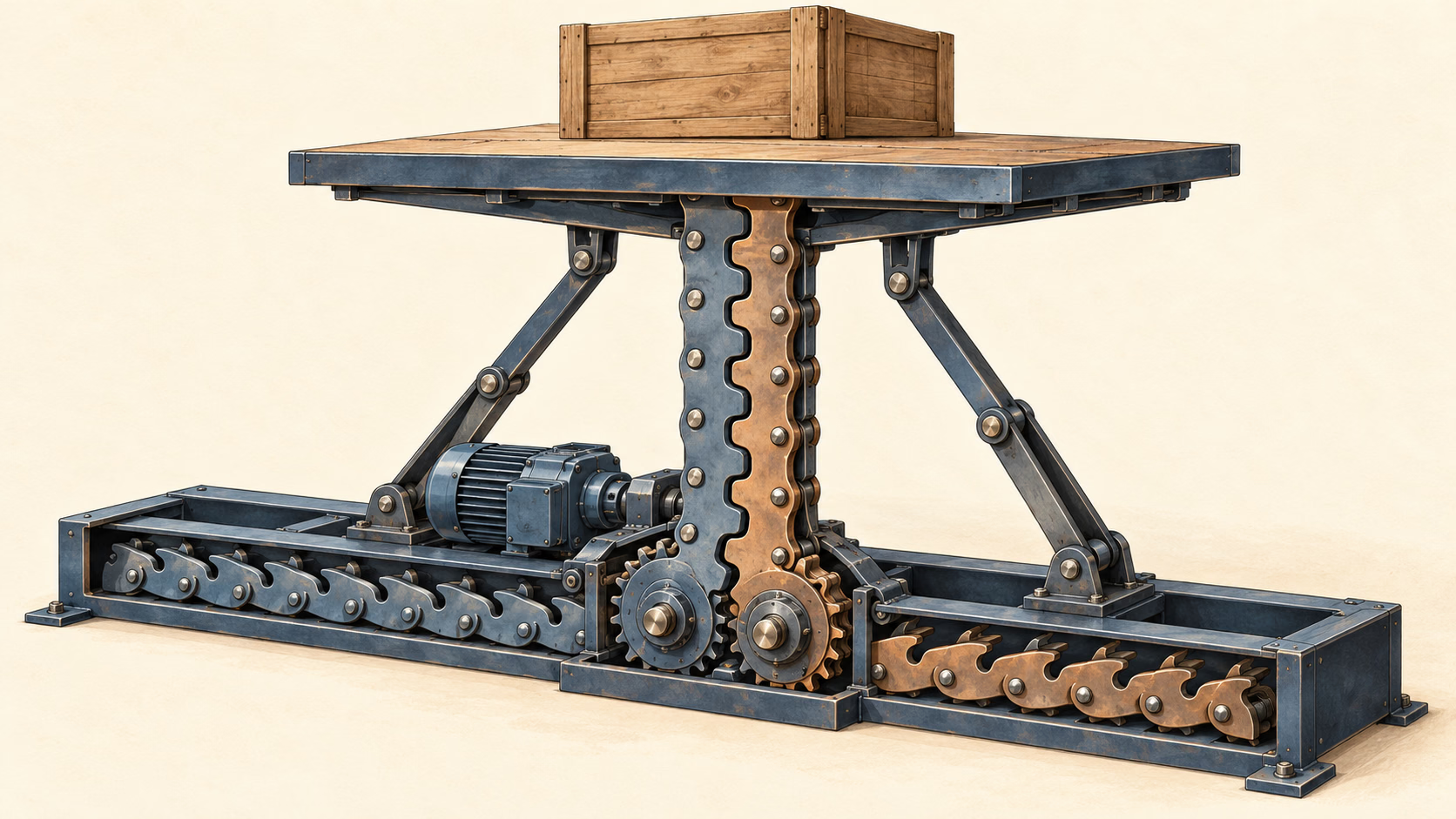
Tsubakimoto meshes two chains to lift a load
Tsubakimoto makes industrial chains, gear reducers, conveying systems and chains for vehicle engines. It supplies machinery makers, automakers and logistics operations with components and equipment that transmit power and move goods.
Different margins in two motion-related businesses
Actual results for the year ended March 2026. Operating profit divided by each segment’s sales, in percent; sales include intersegment transactions. Both bars start at zero. Targets are not plotted.
Source: Integrated Report, PDF p.12. Sales scope: results presentation, PDF p.3.
Bend for storage, interlock to push
Bend for storage. Interlock to lift.
A schematic lift showing the chain-storage area and the loaded tabletop. Copper and navy distinguish the two interlocking chains.
Retracted
Separate chains fit into the space below the tabletop.
Extended
The interlocked column pushes the tabletop directly upward.
Partly cut away to show the mechanism. Dimensions, colors and storage paths are schematic, not a model-specific engineering drawing. Real equipment uses guides and guards suited to the application.
Source: ZIP CHAIN mechanism (Japanese)Lifter product explanation (Japanese)
Transmit the force directly to the lifting table
Extend the combination into development and sales
The work the combined business aims to expand
Policy described in the integrated report published in October 2026.
- Propose product combinationsWork across chains, reducers and linear actuators
- Connect development and productionDeploy people and production functions together
- Support equipment after installationUse technical representatives and customer data in after-sales work
THE VIEW AFTER THE NUMBERS
What the numbers suggest
Tsubakimoto’s ZIP CHAIN meshes two flexible chains into a column that can push a load. Chain technology reaches the customer both as components and as lifting equipment.
Yet Chain and Motion Control earned operating margins of 15.1% and 4.1% in the year ended March 2026. Their combination in the following fiscal year aims to broaden product proposals and work after installation. The company intends to pursue growth through cross-product proposals and after-sales service, but does not quantify the earnings contribution of each measure.
Primary sources used
TSUBAKI REPORT 2026 (Japanese)
Tsubakimoto Chain Co. · 2026-10-01
Pages used: p.12 / p.33-34 / p.63-64
Open source →Full-year results for March 2026 (Japanese)
Tsubakimoto Chain Co. · 2026-05-29
Pages used: p.3,7
Open source →ZIP CHAIN mechanism and product range (Japanese)
Tsubakimoto Chain Co.
Open source →ZIP CHAIN LIFTER product details (Japanese)
Tsubakimoto Chain Co.
Open source →