TORIDOLL Holdings Corporation · Year ended March 2026
Marugame's kitchen starts with a bag of flour
Toridoll is a restaurant group operating brands in Japan and overseas, including Marugame udon shops and Hawaiian-themed Kona's Coffee. At its core Marugame business, staff make the noodles served to diners from flour inside each restaurant's kitchen.
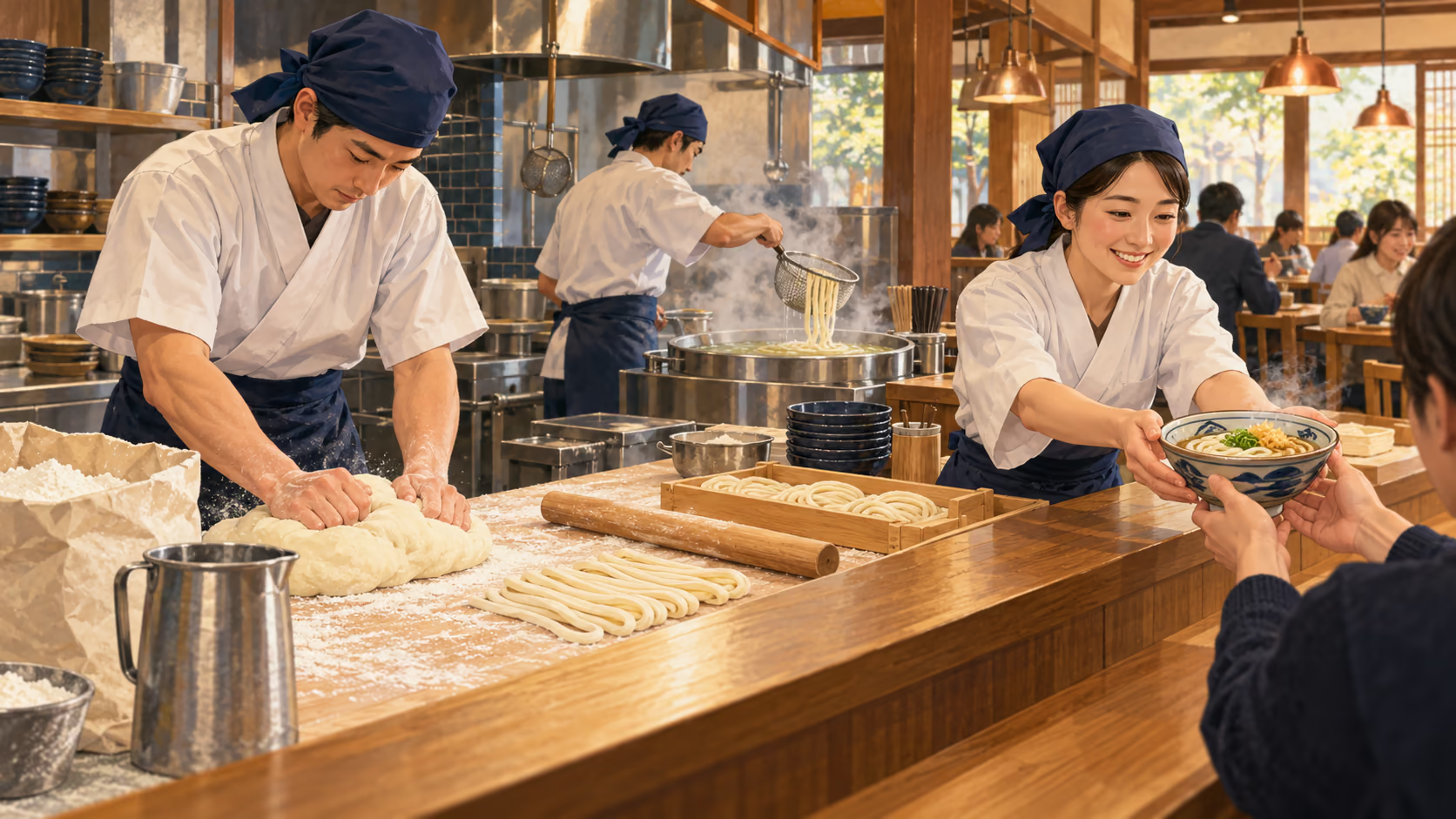
Flour becomes a bowl of udon inside the kitchen
Restaurant staff turn ingredients into dough and noodles, then serve them to diners.
Within one restaurant
1Make the dough
Combine flour, water and salt.
2Rest, stretch and cut
Adjust steps such as resting time to the condition of the dough.
3Boil the noodles
Boil the cut noodles in the restaurant kitchen.
4Serve the diner
Hand the finished udon to a customer.
A simplified schematic of the process and tools, not a literal kitchen plan or a claim that every worker shown holds the noodle-master qualification.
Source: Marugame announcement, March 21, 2024, PDF pp.2, 4–5 (Japanese)
Daily noodle-making across 887 stores
Making noodles in each kitchen also puts the work of responding to the day’s materials and conditions in each location.
Keeping noodle-making inside each restaurant
Kitchen work combines with a system for developing and checking skills.
- Assess the ingredientsAdjust the process to the season and dough
- Check the skillsPractical and written tests, followed by continued learning
- Cook and serveMake and boil the noodles within the kitchen
Marugame anchors the group’s earnings
Marugame has the largest segment business profit
Year ended March 2026. Segment business profit in ¥bn, before the adjustment for unallocated company costs. All three bars use the same zero-based scale.
Source: Financial Results, PDF p.6 / printed p.3. Consolidated business profit was ¥21.460bn after an adjustment for ¥9.933bn of company costs not allocated to the segments. Adding the three bars does not give consolidated profit.
THE VIEW AFTER THE NUMBERS
What the numbers suggest
Marugame’s kitchens contain both the process of turning ingredients into noodles and the skill of judging the dough. At March 2026, its directly operated Japanese network had 887 stores carrying out that on-site work.
Alongside the core segment’s ¥21.955bn business profit, the kitchen process shows what expanding this restaurant business entails: developing the people who cook in each location. Together with managing products, prices and costs, that everyday production work supports Toridoll’s restaurant business.
Primary sources used
FY March 2026 Consolidated Financial Results, IFRS (Japanese)
TORIDOLL Holdings Corporation · 2026-05-15
Pages used: p.5 / p.5-6 / p.6
Open source →Noodle Masters Assigned to All Marugame Stores (Japanese)
Marugame Seimen, Inc. · 2024-03-21
Pages used: p.2-3 / p.4-5
Open source →