Nitto Boseki Co., Ltd. · Year ended March 2026
The glass cloth Nittobo supplies for AI circuit boards
Nittobo makes materials and products including glass fiber for electronic boards, insulation for homes and diagnostic reagents. Its electronic-materials business supplies glass yarn and woven glass cloth to customers such as copper-clad laminate manufacturers.
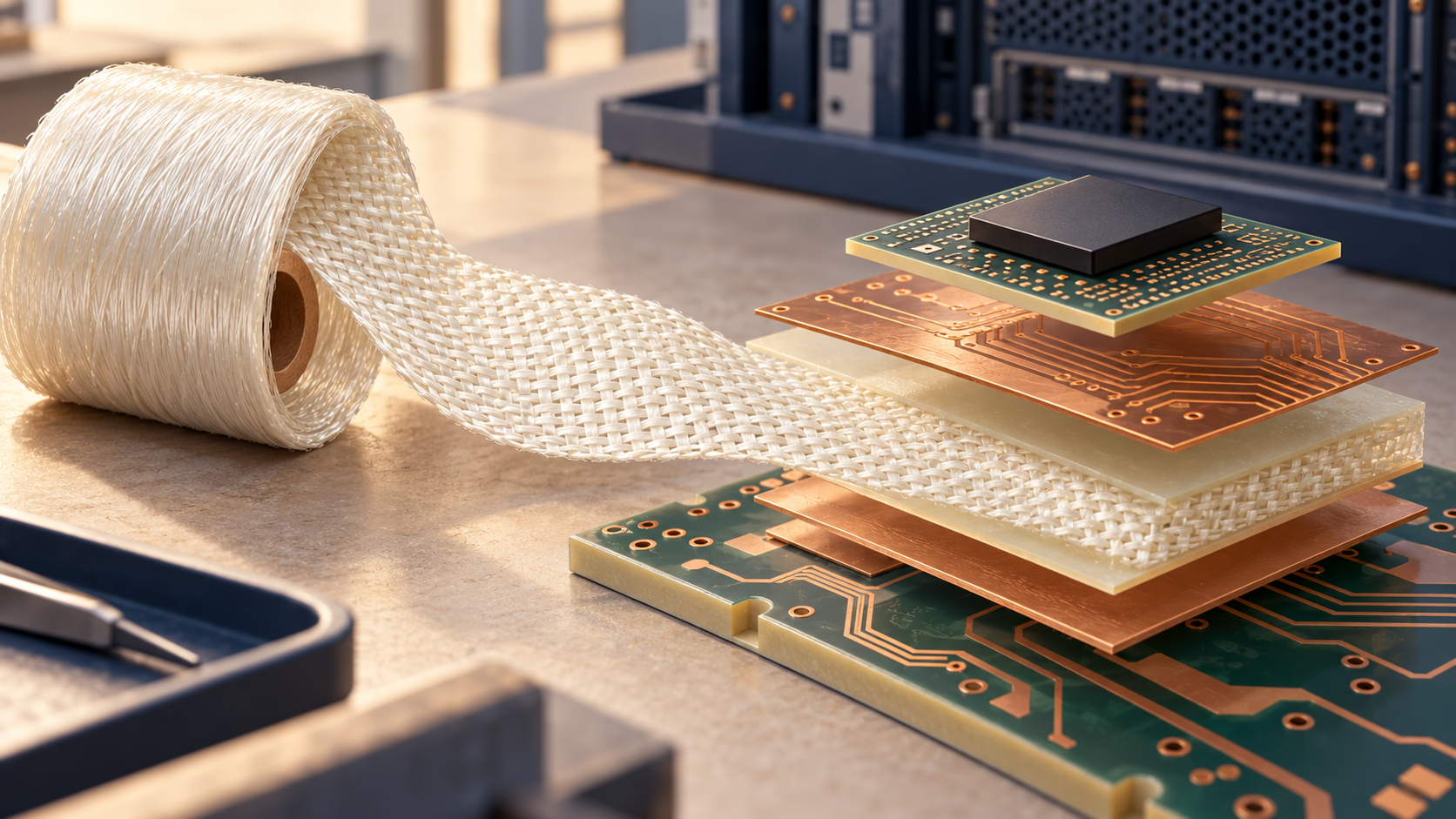
From glass yarn to the inside of a board
Nittobo’s materials pass through laminate and circuit-board manufacturing before becoming part of electronic equipment.
Nittobo
Supply yarn and cloth
Fine glass yarn is woven and treated to make cloth. Nittobo also sells the yarn itself.
Laminate and board makers
Combine cloth, resin and copper
- Copper foil
- Glass cloth
- Resin
Cloth is combined with resin. Inside the copper-containing board, it provides insulation and reinforcement.
Manufacturers using the boards
Boards beneath the chip
Chip → Package substrate → Motherboard
Glass cloth is used in the package substrate beneath a chip and in the motherboard below it.
Simplified structure and layer count. Glass types are selected for their applications.
Source: Integrated Report 2026, PDF p.25 (printed p.24; Japanese)
Different glasses for signal loss and board warpage
Deciding which production steps will meet growing demand
Electronic-materials sales to external customers
Actual results for the years ended March 2025 and March 2026, in ¥ million. Excludes intersegment sales; a common scale starts at zero. Source: financial results, PDF pp.16–17.
Dividing the work of supplying more glass cloth
Policy described in September 2026. This does not state that weaving for every product will move outside the group.
- Melt glass and spin yarnConcentrate on special compositions and extremely fine yarn
- Collaborate in weavingOutsource weaving work to Nan Ya Plastics
- Finish the clothStrengthen surface-treatment technology and capacity
Consolidated net income also includes an asset-sale gain
THE VIEW AFTER THE NUMBERS
What the numbers suggest
Nittobo supplies woven glass that insulates and reinforces electronic boards. Within that material family, NE/NER limits signal loss while T glass addresses thermal expansion and warpage.
Serving the growth in electronic materials takes more than designing a composition. It requires consistent high-volume production of fine yarn and thin cloth, and additional capacity at the necessary processing stages. Outside collaboration in weaving and investment in Nittobo’s own facilities are choices about how to provide that supply.
Primary sources used
FY March 2026 Consolidated Financial Results (Japanese)
Nitto Boseki Co., Ltd. · 2026-05-12
Pages used: p.1,10,17 / p.4,16-17
Open source →Nittobo Group Integrated Report 2026 (Japanese)
Nitto Boseki Co., Ltd. · 2026-09-30
Pages used: p.19 / p.20,34 / p.25 / p.34-35
Open source →