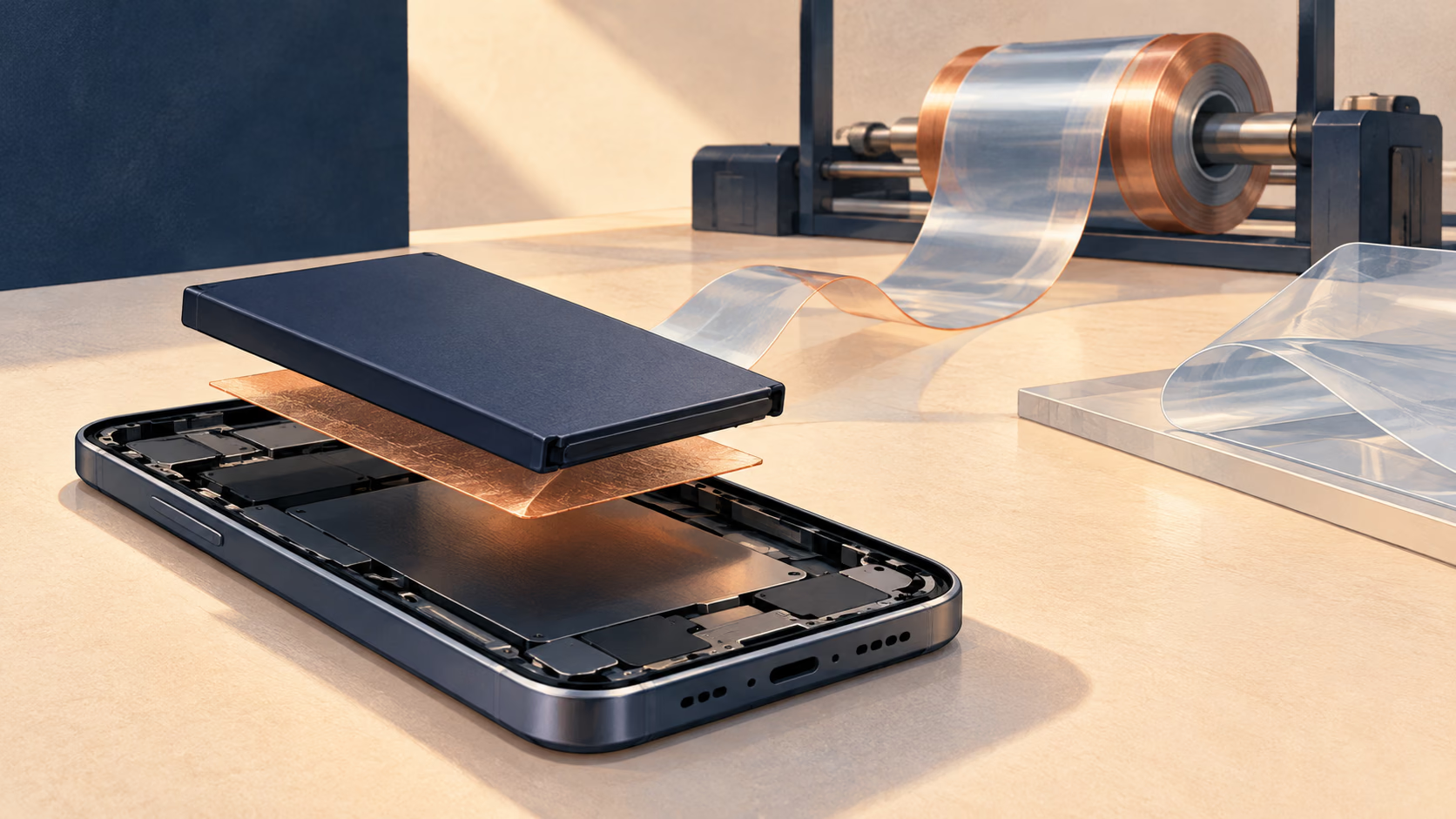
Nitto designs tape for the day a battery comes out
Nitto makes materials for manufacturers of products such as smartphones and cars, including tapes that secure components and optical films used in displays. One of its tapes holds a smartphone battery in place while allowing it to be removed more easily later.
Why would easier removal increase demand for a tape that holds a battery in place? The same bond has a different job when a smartphone is assembled and when it later needs repair.
Hold the battery during use, release it for replacement
Build a release mechanism into the bond
An enlarged schematic of the battery-to-housing bond, using conductive surfaces on both sides of the adhesive as an example.
1Keep the battery secure
The adhesive beneath the battery bonds to the housing-side surface.
2Apply voltage across the adhesive
Release ingredients gather at the interface, reducing adhesion.
3Lift the battery from the housing
Separation makes battery replacement and sorting materials easier.
Shapes and thicknesses are not to scale. Voltage is applied to the bonded surfaces, not the battery terminals. Actual structures and conditions vary by application. These are not repair instructions.
Being able to detach components makes it easier to replace a battery or separate different materials during disassembly. Nitto sells the material incorporated into the finished phone. For the device manufacturer, it provides a way to design in both secure fixation and easier removal.
The release function has to survive the customer’s process
Making an adhesive release in a test, adapting that performance to a customer’s assembly process and supplying the required volume are connected jobs. Commercializing the tape calls for work across material design and delivery.
Wider adoption appears in the March 2026 results
DATA VIEW
Revenue grew across the Industrial Tape segment
Consolidated segment revenue in ¥bn, comparing full years ended in March on the same zero-based scale. These are not electrical-release tape sales alone. Source: Integrated Report 2026, PDF p.49 (printed p.48).
Year ended March 2025¥351.829bn
Year ended March 2026¥366.607bn
More adopting models expand the range of devices into which Nitto’s material is built. Production trends in phones, cars and other end markets also affect overall tape sales. The planned plant is intended to add supply for demand beyond these existing sales.
Carrying release technology into the next application
CONCEPT MAP
One tape, from assembly to removal
The roles surrounding electrical-release tape. The planned plant covers several adhesive materials serving these applications.
Design the bond and its releaseNitto adhesive materials
Nitto supplies the materialChecks material and quality against the customer's process
Device makers incorporate itHolds the battery firmly during use
Removal during repair or disassemblyVoltage weakens adhesion to aid replacement and sorting
The Toyohashi plant is planned for completion in January 2028. Existing sales and future facilities are distinct.
THE VIEW AFTER THE NUMBERS
What the numbers suggest
Nitto’s electrical-release tape has a job while it is attached and another when it needs to come off. The company adapts its performance to customers’ processes and supplies a material for devices designed with repair in mind.
Adoption spread to more models in the year ended March 2026, when the broader tape segment also grew. The roughly ¥39bn Toyohashi plant project is intended to expand supply of electrical-release tape and adhesive materials for foldable devices. Performance at the moment of removal connects Nitto’s research to its next capacity investment.
Tsubakimoto uses chain geometry and motion to build equipment that pushes loads upward. ZIP CHAIN meshes two chains into a rigid column, then separates them for storage in a compact case. Its wider Chain and Motion Control businesses nevertheless had very different operating margins in the year ended March 2026: 15.1% and 4.1%. Their April 2026 combination aims to extend product combinations into customer proposals and after-sales service. Its earnings effects still need to be established through future results.