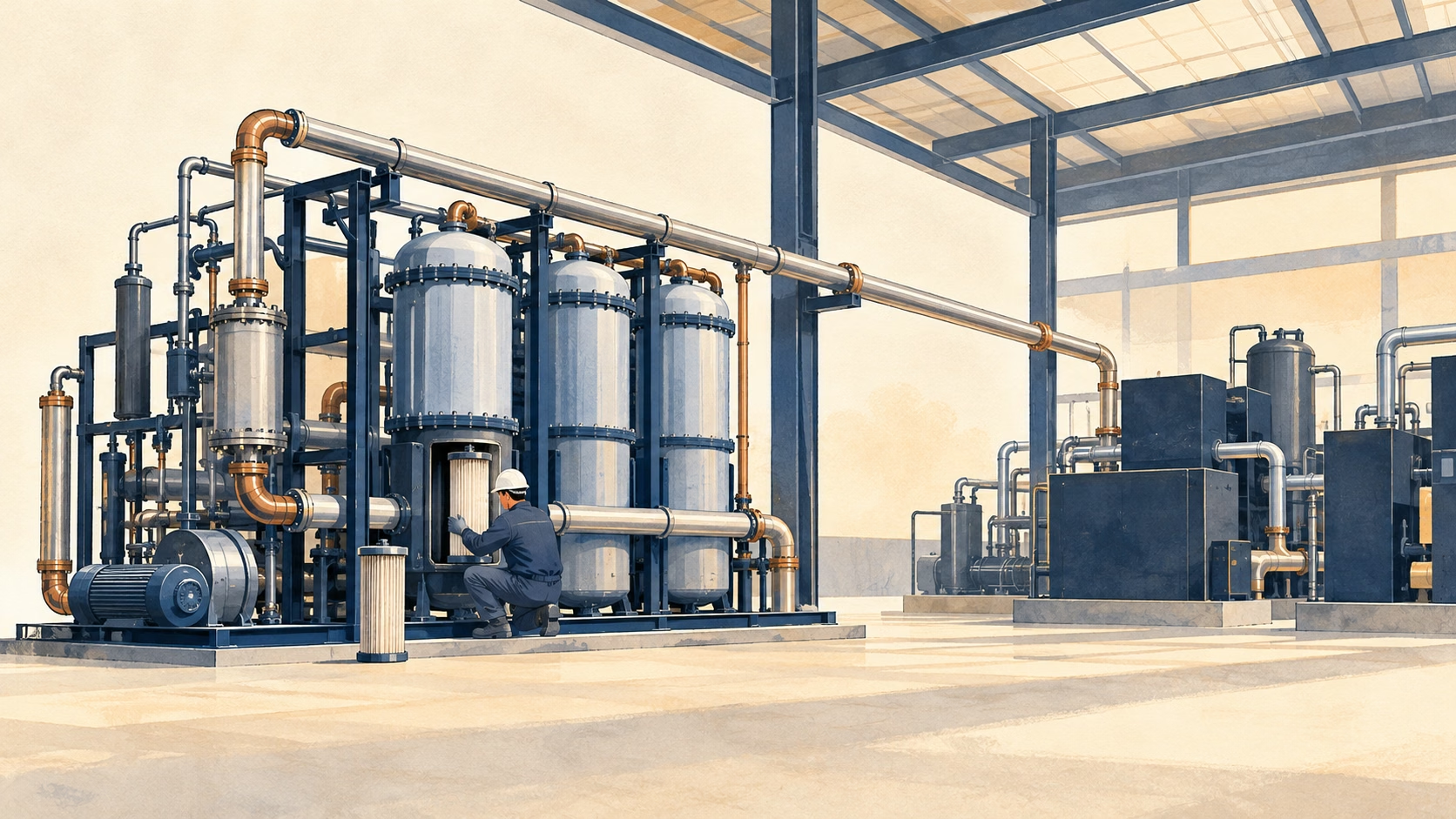
The factory buys water. Kurita owns the equipment.
In one of Kurita’s water-supply arrangements, the factory buys water and Kurita owns the equipment that makes it. Its disclosures for the year ended March 2026 (April 1, 2025–March 31, 2026) show how ownership changes the work and funding each side takes on.
The brochure for the pure-water service KWSS makes this division of work more concrete.
The same factory location, different ownership and work
Equipment delivery and long-term water supply, as described in the 2026 integrated report.
The factory buys equipment
Inside the customer’s factory
Water-treatment equipmentFactory production process
Equipment handed to the customer
Kurita → customer: sell and deliver equipment
Kurita continues with maintenance and chemical supply after handover
The factory buys water
Inside the customer’s factory
Water-treatment equipmentFactory production process
Equipment owned by Kurita
→ Supply water
Customer → Kurita: water fee
Kurita builds, operates and maintains the equipment
In water supply, Kurita’s assets sit inside the customer’s factory. Maintenance also covers other makers’ equipment. This compares delivery models, not revenue categories or an engineering design.
How the equipment is provided changes the relationship between Kurita and the factory.
Water treatment at the customer's factoryAn arrangement suited to investment and management needs
The factory buys equipmentKurita sells and delivers it, then continues with maintenance and chemicals
The factory buys waterKurita builds, owns and operates the equipment; the factory pays for the water
Two delivery models, not mutually exclusive revenue categories. Maintenance also covers other makers' equipment. KWSS's fixed monthly fee and extra installation charge do not apply to every ultrapure-water contract.
The supplier still has to build and invest
Even when the customer does not buy the equipment, someone must fund it and bring it into operation.
When a long-term water-supply contract ends
The accounting when a contract ends can also appear outside service revenue.
Equipment already handed over still needs work
Alongside water supply using retained assets, Kurita continues to support equipment its customers use.
DATA VIEW
Two Electronics services, different revenue movements
External-customer revenue from continuing operations, ¥ million. Prior year: ended March 2025; current year: ended March 2026. All bars use the same zero-based scale; prior-year figures are restated.
Kurita’s work changes with who owns the equipment inside a factory and who operates it. Handover can be followed by maintenance and chemical supply. Retaining ownership means supplying water with responsibilities for construction, investment and day-to-day operation.
In the year ended March 2026, contract termination affected Electronics recurring contract-based services, and a termination settlement gain was recorded in other income. Maintenance revenue grew against a backdrop of customer-factory activity. Long-running customer relationships can involve different funding needs, revenue movements and ways of ending a contract.
Behind a promise to supply water lies the responsibility to provide equipment and keep supporting its operation. Following asset ownership reveals work that a service-revenue ratio alone cannot describe.
JEOL’s electron-beam writers are used in making the gratings in DFB lasers for optical communications. Spot-beam orders and sales rose in the year ended March 2026, while fewer mask writers were sold and industrial-equipment sales declined. Following what each machine patterns, and where it sits in its customer’s production process, reveals different demand conditions within semiconductor-related equipment.