Hamamatsu Photonics K.K. · Year ended September 2025
Hamamatsu’s role before a faulty chip is opened
Hamamatsu Photonics makes optical sensors, light sources and measurement systems built around them. It supplies components and equipment to semiconductor makers, medical and analytical instrument manufacturers, and research institutions that need to measure faint signals beyond ordinary vision.
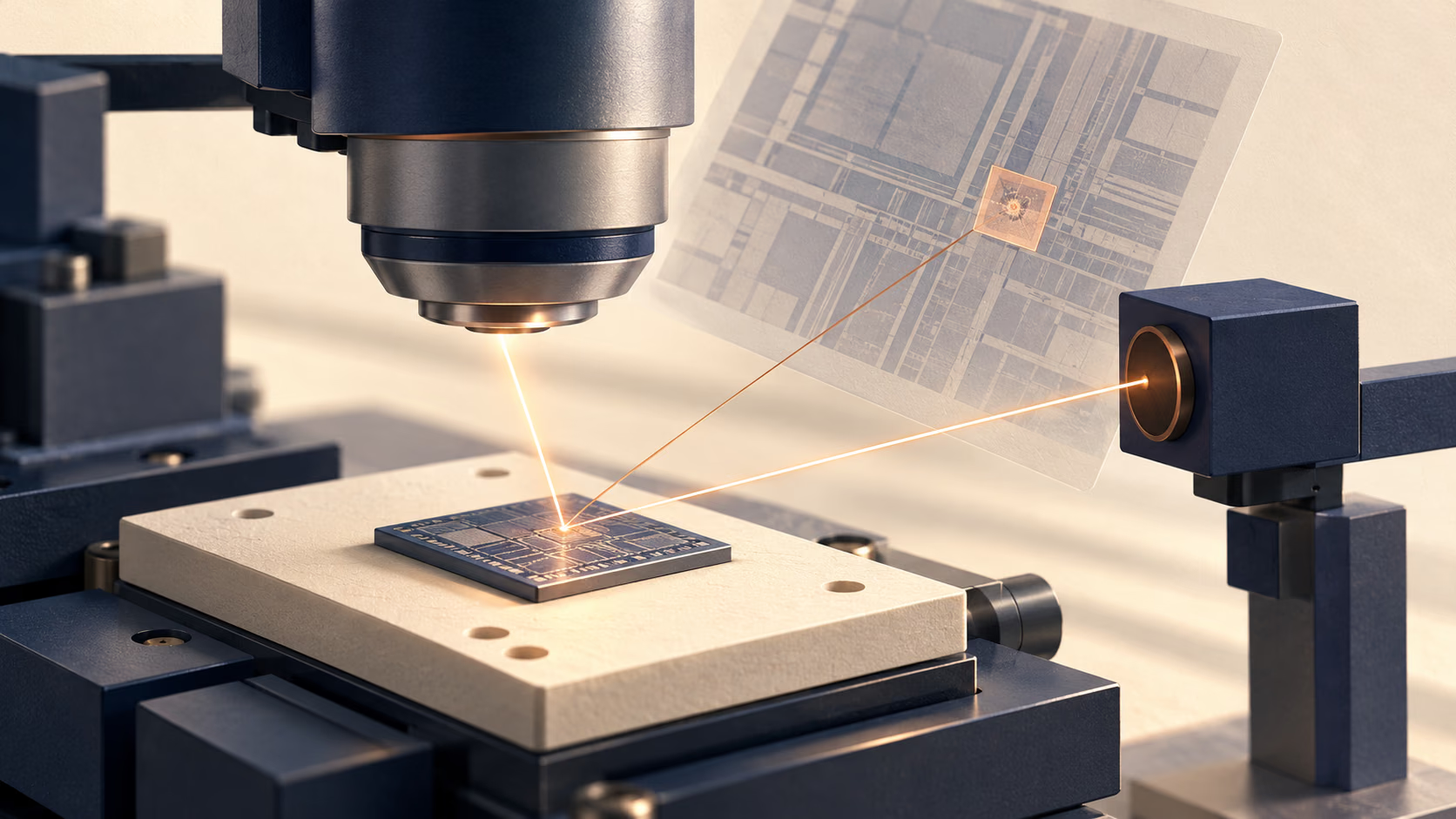
Read heat beneath metal through reflected light
Reflected light narrows the search
A conceptual view of TD Imaging. The laser measures changes in reflectance at the chip’s surface.
1Read the change in reflectance
Localized heating beneath the metal changes reflectance directly above it. An optical detector reads that change.
2Localize, then investigate
The signal narrows the area to examine. Physical analysis with an electron microscope or other equipment then investigates the cause.
A see-through explanatory schematic, not the instrument’s optical layout, layer dimensions or an actual measurement image. Non-destructive localization precedes physical analysis.
Combine optical components into a working instrument
Three jobs on the way to a failure’s cause
The chipmaker’s analysis process, organized by the equipment’s role.
- Tester detects an abnormalityCheck electrically whether the device has failed
- PHEMOS-X narrows the locationUse light and heat; TD Imaging detects changes in reflectance
- Electron microscope investigates the causePhysically analyze the localized area
Failure-analysis sales reached ¥10.4bn
Industrial and medical demand moved in different directions
Sales by application, full-year actuals for September year ends. Unit: ¥bn. All four bars share a zero baseline. These are selected applications, not the group’s entire sales breakdown.
Source: FY2025 Financial Results Briefing, p.9.
Bring the analysis into the production line
THE VIEW AFTER THE NUMBERS
What the numbers suggest
Hamamatsu turns optical signals into information about where a chip has failed. It combines sensors, lasers and image processing into equipment that narrows the area for subsequent physical analysis. That is a concrete job it performs for semiconductor manufacturers.
Failure-analysis system sales were ¥10.4bn in FY2025. Different demand conditions in medical-bio applications and higher group expenses also matter: improving the precision of a technique and selling equipment profitably are both part of the business.
Primary sources used
Integrated Report 2025
Hamamatsu Photonics K.K.
Pages used: p.11 / p.24
Open source →FY2025 Financial Results Briefing
Hamamatsu Photonics K.K. · 2025-11-07
Pages used: p.9 / p.17 / p.31
Open source →TD Imaging Module for PHEMOS-X Series: May 8, 2025 Release
Hamamatsu Photonics K.K. · 2025-05-08
Pages used: p.1 / p.1-2 / p.3
Open source →