Calbee, Inc. · Year ended March 2026
Calbee’s potato purchasing moves sorting beyond harvest
Calbee makes foods including potato chips, Jagarico potato sticks and Frugra granola, selling them to consumers through retailers. Its group company Calbee Potato supports contracted growers with cultivation and harvesting, then buys, stores and supplies potatoes to factories.
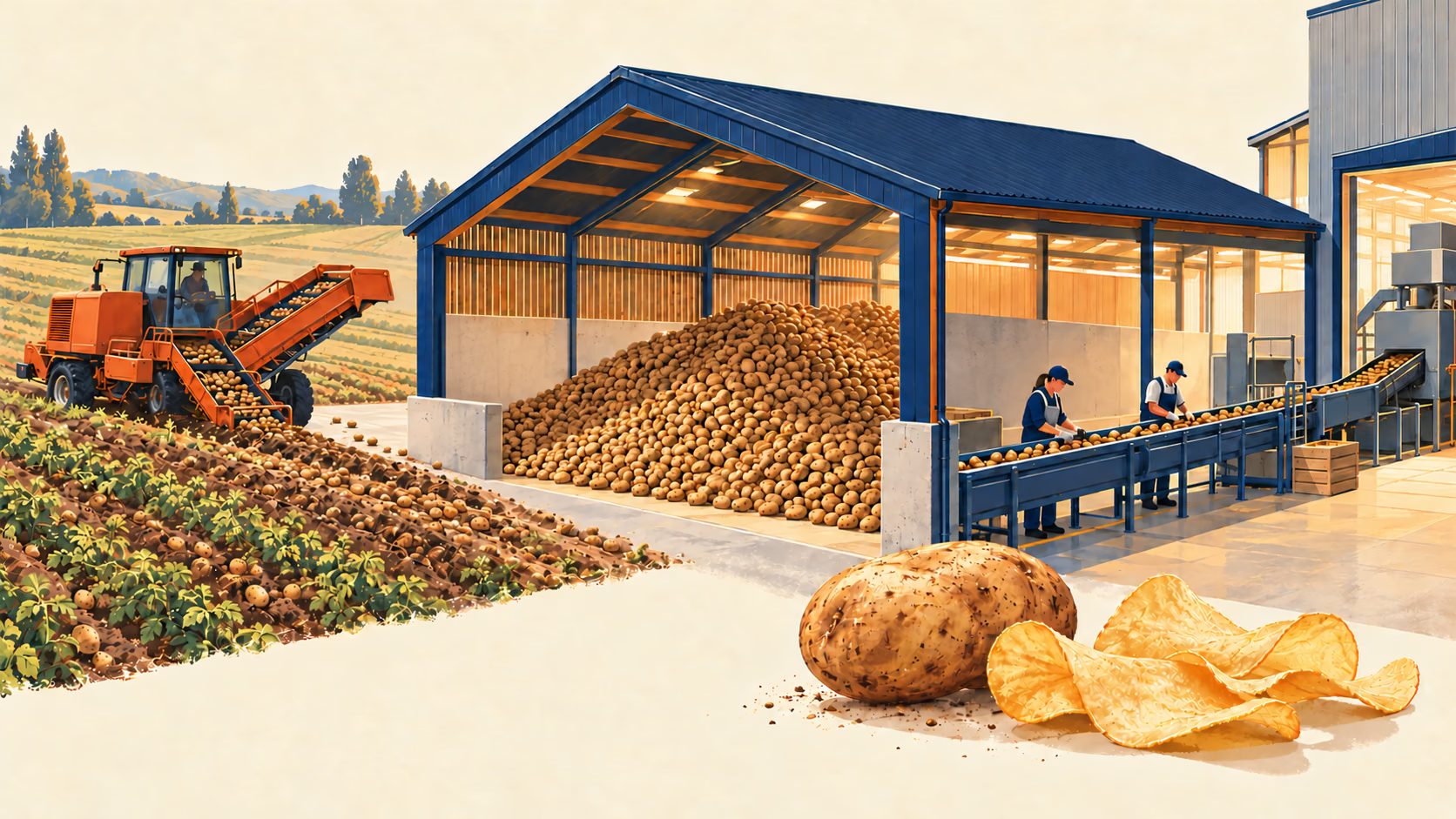
Sort when the potatoes leave storage
Calbee Potato’s approach to reducing harvest-season work: take in the crop, store it loose, then sort at dispatch.
- 1
Support harvesting
Buy the contracted crop in full. Contract harvesting with large machinery also supports growers.
- 2
Store potatoes loose
Manage freshness according to the potatoes’ condition and the weather.
- 3
Sort at dispatch
Sort after storage, when dispatching. This moves work away from the busy harvest period.
- 4
Supply the factory
Transport the raw material when needed to support food production.
Schematic of the disclosed approach. Equipment shapes, scale and sorting method are illustrative. The source does not state what share of total procurement uses this method.
Source: FY March 2026 H1 results presentation, pp.28–30 (Japanese)
Storage connects different harvest seasons
Japanese-origin potato procurement by the domestic group
Unit: tonnes. Actual results for years ended March. Includes primary-processed products and merchandise. Both bars share a zero-based scale.
Source: ESG Data, p.2 (Japanese).
Field observations guide factory supply
What needs managing between field and factory
Keeping products available involves accepting the harvest, managing its condition and meeting the requirements of production.
- Harvest workloadCultivation support, contract harvesting and full-crop purchasing
- Quality in storageManagement adapted to the crop and weather; sorting at dispatch
- Usable factory inputCrop quantity and quality affect sales volumes and production costs
Raw-material quantity and quality reach sales and costs
Adapting processing while waiting for the next harvest
THE VIEW AFTER THE NUMBERS
What the numbers suggest
Calbee combines full-crop purchasing, loose bulk storage and sorting at dispatch to reduce work at harvest time. In FY March 2026, Japanese-origin potato procurement by its domestic group fell from 371,000 to 341,000 tonnes, including primary-processed products and merchandise. Raw-material quantity and quality affected sales volumes and costs, while starting a new factory also carried costs. Keeping snacks available involves helping with harvesting, storing the crop and supplying usable material to factories.
Primary sources used
FY March 2026 H1 Results Presentation (Japanese)
Calbee, Inc. · 2025-11-05
Pages used: p.28-29 / p.30
Open source →Calbee Group Integrated Report 2026 (Japanese)
Calbee, Inc. · 2026-09-25
Open source →ESG Data: FY March 2022–2026 (Japanese)
Calbee, Inc.
Pages used: p.2
Open source →FY March 2026 Results Presentation (Japanese)
Calbee, Inc. · 2026-05-14
Pages used: p.7 / p.14 / p.19
Open source →FY March 2027 Q1 Results Presentation (Japanese)
Calbee, Inc. · 2026-07-30
Open source →