Sumitomo Forestry Co., Ltd. · Fiscal year ended December 2025
The numbers stop fitting if you think of Sumitomo Forestry as a Japanese homebuilder.
Sumitomo Forestry is easy to picture as a Japanese wooden-home builder. That image still matters, but the FY2025 numbers no longer fit inside it. Group sales reached ¥2.268 trillion. The U.S. single-family housing business alone generated ¥786 billion of sales and ¥105 billion of recurring income. The company describes that one business as roughly 60% of consolidated recurring income. A company whose roots go back to forest management around a copper mine in 1691 now earns much of its profit from homes built in the United States.
This is not investment advice or a stock recommendation. We reorder company-published primary-source facts to make the shape of the business easier to see.
Sumitomo Forestry is easy to picture as a Japanese wooden-home builder.
That picture is not wrong.
But the current profit structure is much more international.
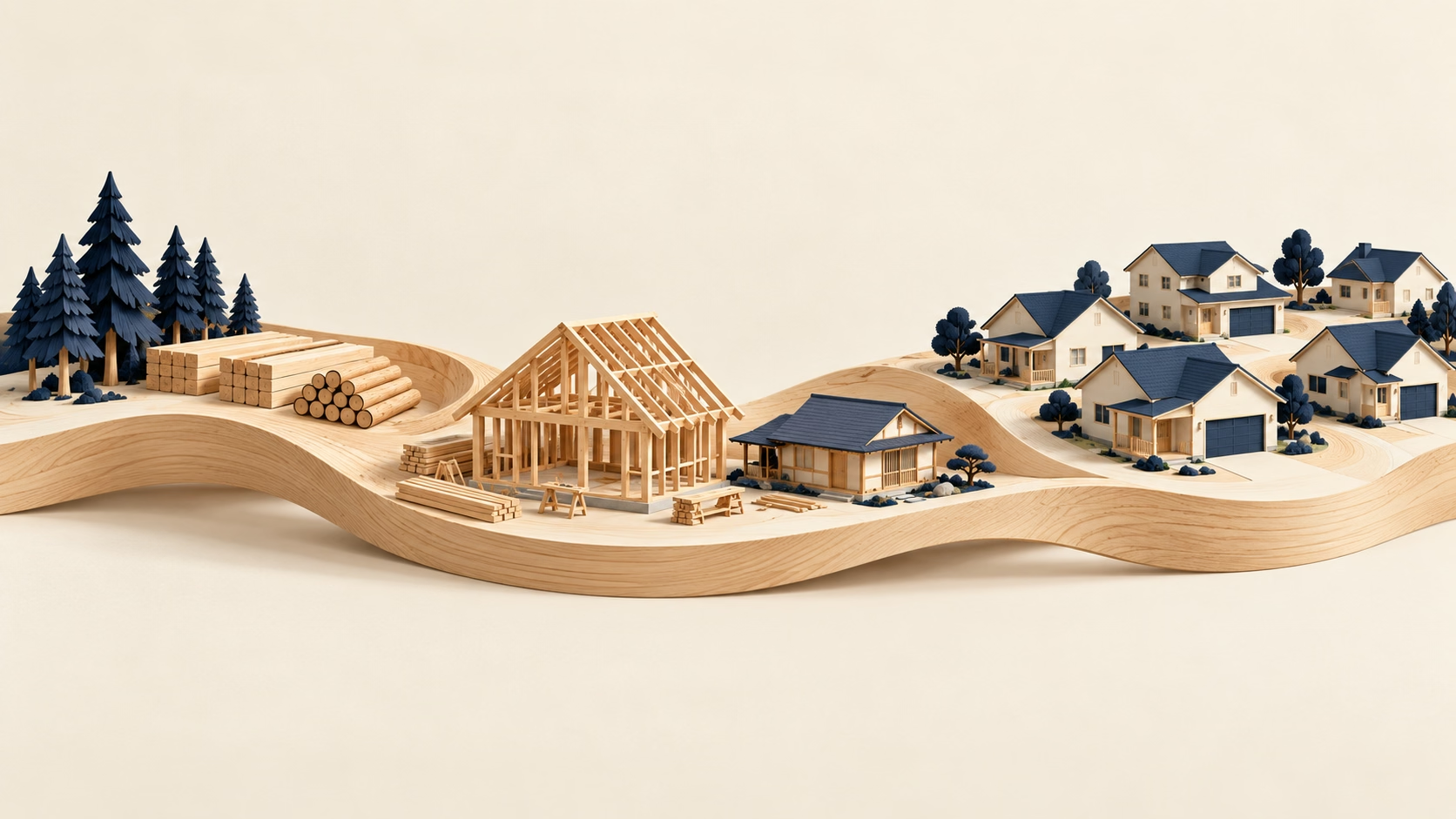
Forestry, timber and domestic and overseas housing maquettes share one wood-grain surface. An editorial interpretation, not a timber-export route, unit or profit proportions, or an actual development plan.
Sales are ¥2.268 trillion
Within that scale, U.S. housing has become very large.
U.S. single-family housing generates ¥786bn of sales
Its profit contribution is even more striking.
Recurring income is ¥105bn
The numbers do not fit inside a Japan-only homebuilder image
FY2025 group scale and U.S. single-family housing.
By unit sales, Sumitomo Forestry was already a major U.S. builder.
11,267 U.S. homes in FY2024
Australia adds another overseas housing market.
17,666 homes across the U.S. and Australia
The domestic housing history is also substantial.
About 370,000 homes delivered in Japan cumulatively
Why does a company called “Forestry” build homes at this scale?
The answer begins much earlier than its housing business.
The origin was forest management around a copper mine in 1691
Those forests eventually needed to be rebuilt.
A major reforestation plan began in 1894
Growing forests led naturally into handling timber.
Handling timber led into building.
From forest to timber, housing and energy
That housing business then grew far beyond Japan.
So the current company makes more sense when the familiar Japanese housing brand is placed inside a much larger overseas operation.
THE VIEW AFTER THE NUMBERS
What the numbers suggest
Sumitomo Forestry generated ¥2.2676 trillion of sales in FY2025.
Its U.S. single-family housing business alone generated ¥786 billion of sales and ¥105 billion of recurring income. The company describes that business as roughly 60% of consolidated recurring income.
Existing U.S. builders sold 11,267 homes in FY2024, ranking ninth in the country according to company materials. Across the U.S. and Australia, FY2025 sales and deliveries reached 17,666 units.
Yet the group’s origin is forest management around the Besshi Copper Mine in 1691.
It learned to secure timber, restore forests, distribute wood and build homes.
Sumitomo Forestry therefore looks less like a Japanese homebuilder that happened to expand overseas and more like a long wood-centered value chain whose housing business became very large overseas.
Primary sources used
Sumitomo Forestry official website
Sumitomo Forestry Co., Ltd.
Open source →Acquisition of Tri Pointe Homes, Inc. presentation
Sumitomo Forestry Co., Ltd. · 2026-02-13
Open source →A look at the history of Sumitomo Forestry
Sumitomo Forestry Co., Ltd.
Open source →Message from the President
Sumitomo Forestry Co., Ltd.
Open source →