Murata Manufacturing Co., Ltd. · Fiscal year ended March 2026
¥1.8 trillion from parts you barely see: inside Murata.
Murata's name rarely appears on the outside of the products that use its components. Yet FY2025 revenue reached ¥1.831 trillion. Components alone represented 63.3%, while capacitors generated ¥936.4 billion. The company started in 1944 in a roughly 150-square-meter Kyoto workshop producing titanium-oxide ceramic capacitors. From parts hidden inside radios, Murata expanded into the components and modules hidden inside servers, smartphones and vehicles.
This is not investment advice or a stock recommendation. We reorder company-published primary-source facts to make the shape of the business easier to see.
Murata’s name is rarely visible on the outside of a smartphone, server or vehicle.
Yet the company generates more than ¥1.8 trillion in annual revenue.
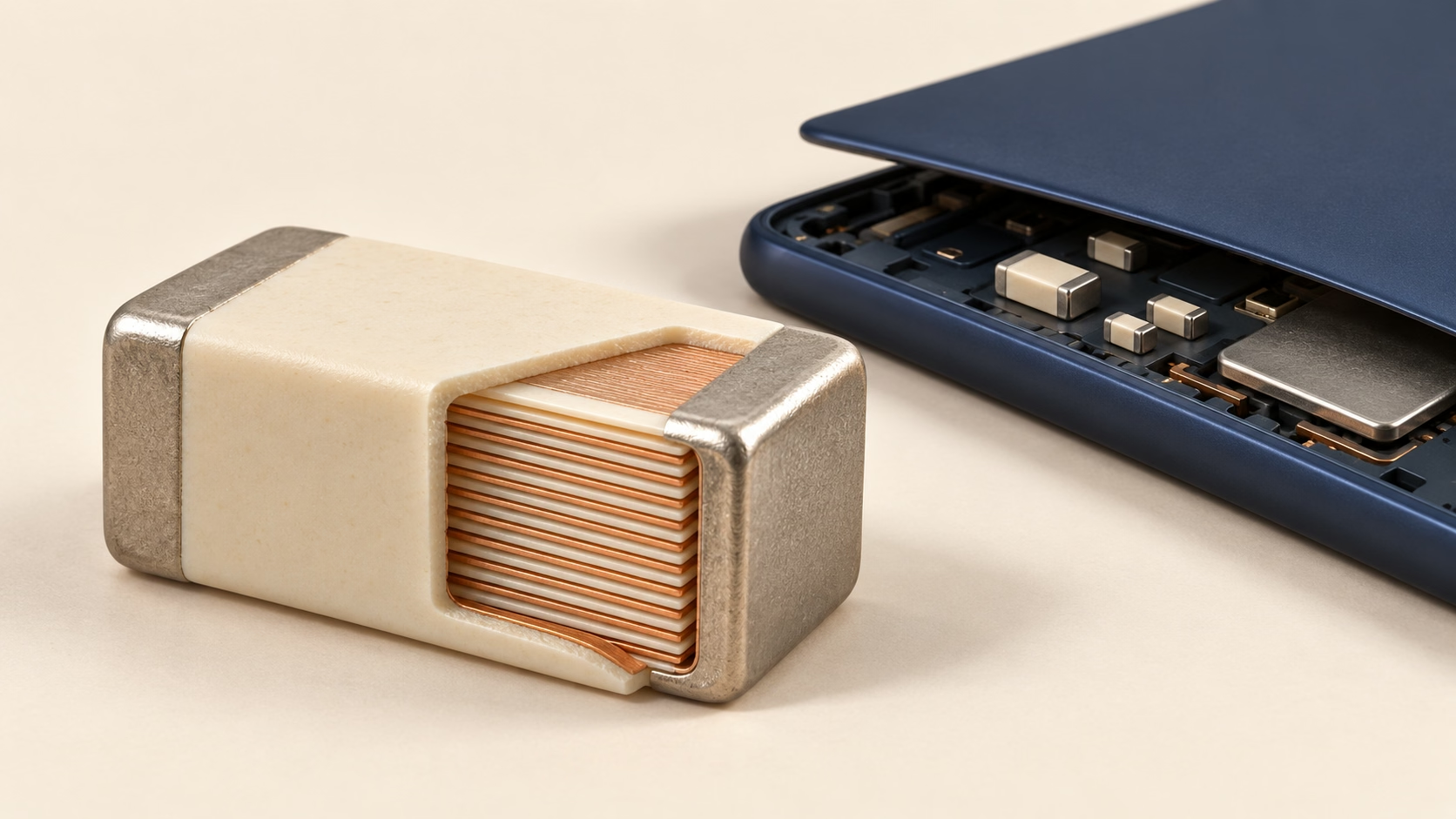
An enlarged layered component and a device-interior maquette interpret largely invisible component technology. Not actual dimensions, circuit layouts, a specific customer design or a claim of finished-device manufacturing.
Revenue is ¥1.831 trillion
The center of that scale is components.
Components generate ¥1.160 trillion
Capacitors are by far the largest item.
Capacitors alone generate ¥936.4bn
Murata is not only a capacitor company.
Devices and Modules generate ¥656.0bn
Almost all revenue comes from things embedded inside electronics
Company-disclosed FY2025 categories.
Communications products alone are a large business.
High-frequency and communications modules are ¥394.8bn
Power-related products form another branch.
Batteries and power supplies are ¥154.1bn
The company is also large in people.
Murata has 74,302 employees
The origin of this scale was also a tiny component.
It began in a roughly 150 m² workshop in 1944
Those first parts went inside radios.
Murata was invisible from the start
Ceramic materials then moved into other functions.
Ceramics became resonators and filters
Murata still describes itself through the technology behind the part.
The production process is part of the technology
From radios to servers.
From fish finders to smartphones and vehicles.
The finished products changed, while Murata kept occupying the space inside them.
THE VIEW AFTER THE NUMBERS
What the numbers suggest
Murata generated ¥1.8309 trillion of revenue in FY2025.
Components accounted for ¥1.1597 trillion, or 63.3%, and capacitors alone generated ¥936.4 billion.
The company began in 1944 in a roughly 150-square-meter Kyoto workshop producing titanium-oxide ceramic capacitors for equipment such as radios.
It later expanded into piezoelectric resonators, ceramic filters, high-frequency components, communications modules, batteries and power supplies.
Murata rarely owns the brand on the outside of the finished device.
Its scale comes from combining materials, processes, design and production technology to place tiny components inside enormous numbers of electronic products.
Primary sources used
Presentation Material for FY2025
Murata Manufacturing Co., Ltd. · 2026-04-30
Open source →Facts and Figures
Murata Manufacturing Co., Ltd.
Open source →The History of Murata
Murata Manufacturing Co., Ltd.
Open source →Brand Story
Murata Manufacturing Co., Ltd.
Open source →