BROTHER INDUSTRIES, LTD. · Fiscal year ended March 2026
It started with sewing-machine repair: how Brother branched into ¥893.5 billion.
Brother began not by selling a finished machine, but by repairing sewing machines. From that 1908 repair business came the knowledge needed to manufacture sewing machines domestically, including the ability to build parts and production equipment in-house. By FY2025, revenue had reached ¥893.5 billion and Printing & Solutions was the largest segment at ¥570.6 billion. The story is not simply that a sewing-machine company became a printer company. Technologies accumulated while learning to build one machine kept branching into other machines.
This is not investment advice or a stock recommendation. We reorder company-published primary-source facts to make the shape of the business easier to see.
Brother began not with a finished product, but with repair work.
The machine was a sewing machine.
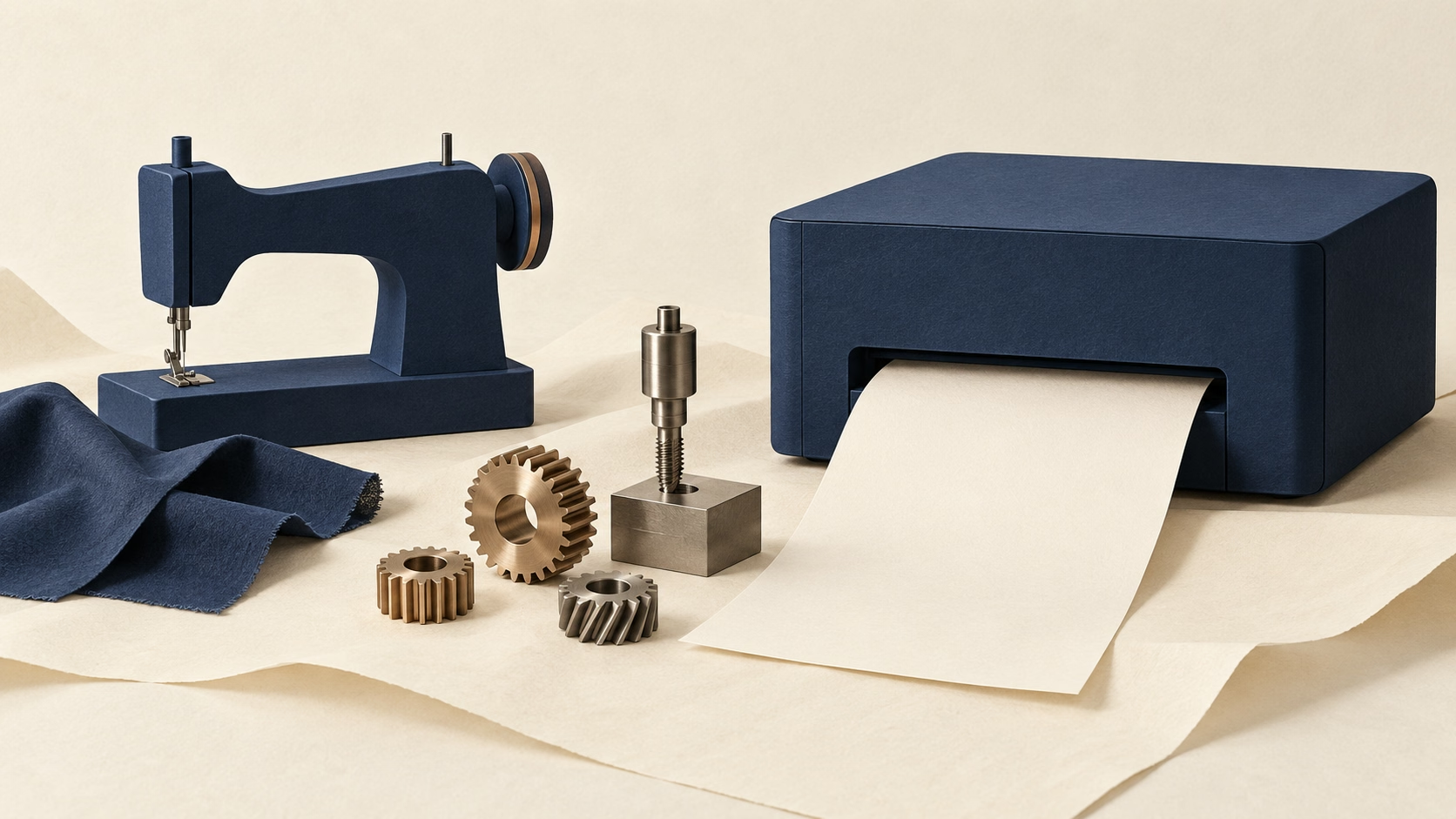
Sewing, machining and printing maquettes interpret branches of manufacturing and control capabilities. Not a claim that every product came from one component or a depiction of actual equipment specifications.
Sales revenue is ¥893.5 billion
The largest current business is not sewing machines.
Printing & Solutions is the largest segment
Printing also extends into industrial settings.
Industrial Printing is ¥139.3bn
Machine tools remain another branch.
Machinery is ¥83.0bn
The original sewing-machine line has not disappeared.
Personal & Home is ¥61.0bn
Brother now spans five main businesses
FY2025 sales revenue, excluding Other and eliminations.
At first glance, sewing machines, printers and machine tools look unrelated.
Brother’s technology history makes the connection much clearer.
It began with sewing-machine repair in 1908
Domestic manufacturing required more than assembling a sewing machine.
It required mastering the processes used to make its parts.
Sewing machines left behind precision and press technologies
The move into machine tools is unusually direct evidence of that path.
In-house sewing-machine technology became a machine-tool business
Another branch led into printing.
High-speed dot-matrix printing arrived in 1971
Electronic control entered sewing machines, numerical control entered machine tools, and motors and control systems became essential to printers.
The products diverged, but the technologies inside them kept overlapping.
39,495 employees across a global business
THE VIEW AFTER THE NUMBERS
What the numbers suggest
Brother generated ¥893.5 billion of sales revenue in FY2025.
Printing & Solutions is the largest business at ¥570.6 billion, alongside Industrial Printing at ¥139.3 billion, Machinery at ¥83.0 billion and Personal & Home at ¥61.0 billion.
The company began with sewing-machine repair in 1908.
Learning to manufacture sewing machines domestically built precision-processing, press-forming and motor capabilities. In 1962, in-house technologies used for sewing-machine processing became the basis of a machine-tool business. In 1971, high-speed dot-matrix printing opened another path, and electronic-control and print-head technologies later fed into fax machines and printers.
Brother therefore did not simply trade sewing machines for printers.
It is a company where technologies accumulated while learning to build one machine became the starting point for the next machine, repeatedly branching into new businesses.
Primary sources used
FY2025 Financial Results / Progress on CS B2027
Brother Industries, Ltd. · 2026-05-08
Pages used: p.7 / p.8
Open source →Corporate Data
Brother Industries, Ltd.
Open source →Product and Technology Timeline
Brother Industries, Ltd.
Open source →Brother Group History 1960s
Brother Industries, Ltd.
Open source →Brother Group History 1970s
Brother Industries, Ltd.
Open source →