NGK Corporation · Fiscal year ended March 2026
From a fragment of an insulator to AI chips: a century of NGK ceramics.
NGK's story begins with a fragment of an insulator. Japan still depended on imported high-voltage insulators when the founders used a piece of an American product as a reference for domestic development. In FY2025, net sales reached ¥670.1 billion. Automotive emissions products are now the largest business, while ceramics used in semiconductor manufacturing equipment are growing with AI-related demand.
This is not investment advice or a stock recommendation. We reorder company-published primary-source facts to make the shape of the business easier to see.
NGK’s story begins with a fragment of an insulator.
FY2025 net sales are ¥670.1 billion, but power insulators alone no longer explain the company.
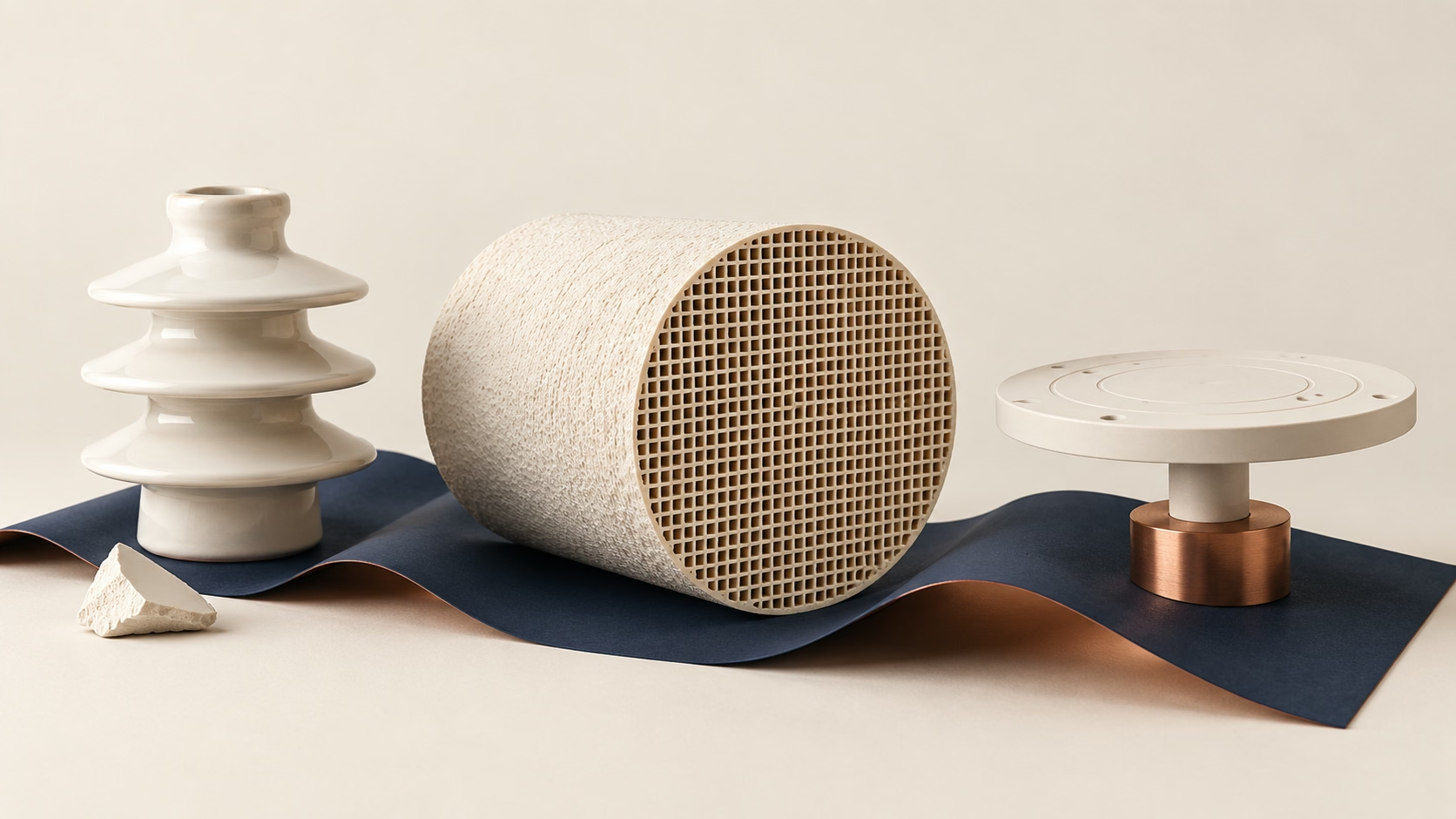
Insulator, porous exhaust substrate and semiconductor-equipment ceramic studies interpret expanding material applications. Not actual specifications, revenue proportions or evidence of performance or emissions outcomes.
Net sales are ¥670.1bn; operating income is ¥95.0bn
Environment represents 59.6%
Digital Society represents 30.7%
NGK's FY2025 business mix
Company-disclosed composition.
A century earlier, the business was much narrower.
It began with a fragment of an American insulator
The insulator business became an independent company in 1919
The ceramic capabilities then moved outside electric power.
Automotive exhaust became a new field in 1976
DPF production followed in 1989
In the 1990s, the same materials base entered semiconductor factories.
Semiconductor manufacturing equipment ceramics arrived in 1996
AI demand lifted the Digital Society business
“Insulators” disappeared from the company name
Insulators, automotive emissions systems and semiconductor manufacturing equipment look far apart as products.
At the materials level, however, each asks ceramics to deliver a difficult combination of shape, heat resistance, insulation, durability or microscopic structural control.
THE VIEW AFTER THE NUMBERS
What the numbers suggest
NGK generated ¥670.1 billion of net sales and ¥95.0 billion of operating income in FY2025.
The company-disclosed business mix is 59.6% Environment, 30.7% Digital Society and 9.7% Energy & Industry.
The story began with domestic high-voltage insulators. Using a fragment of an American-made insulator as a reference point, the founders developed their own ceramics and established the company in 1919.
NGK then moved those capabilities into HONEYCERAM in 1976, diesel particulate filters in 1989 and semiconductor manufacturing equipment ceramics in 1996. In FY2025, Digital Society grew strongly amid AI-related semiconductor demand.
NGK did not replace an insulator business with a semiconductor business.
It kept moving ceramic material and manufacturing capabilities into the difficult applications of each era—from power grids to automobiles to semiconductor factories.
Primary sources used
FY2025 Financial Results
NGK Corporation · 2026-04-30
Pages used: p.3 / p.9
Open source →History
NGK Corporation
Open source →Skills Cultivated through Experience
NGK Corporation
Open source →Corporate Outline
NGK Corporation
Open source →